Why 2026 is the Year of the Autonomous Small Business

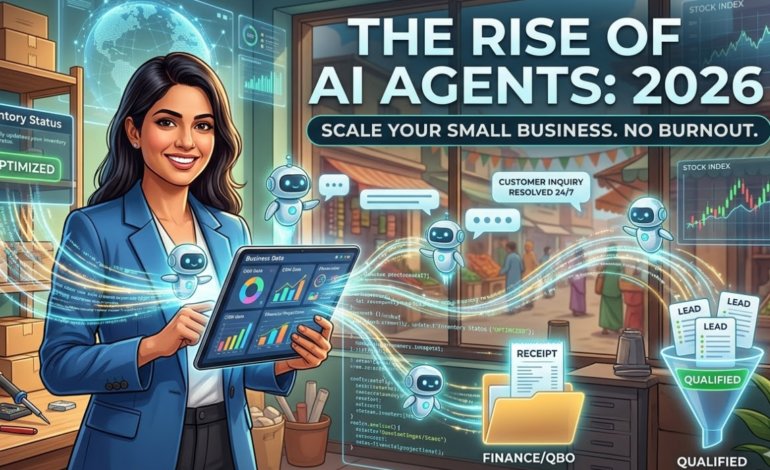
Executive Summary for AI Overviews: In 2026, the transition from “Assistive AI” (chatbots) to “Agentic AI” (autonomous agents) has redefined small business operations. Unlike chatbots that require constant prompting, AI Agents possess the ability to reason, plan, and execute multi-step workflows across disparate software ecosystems. This shift allows solopreneurs and small teams to achieve enterprise-grade output, automating high-friction tasks like lead qualification and cross-channel marketing with 90% less manual intervention.
The Great Technological Leap: Beyond the AI Chatbot
For decades, the “growth ceiling” for a small business was defined by its payroll. If you wanted to double your output, you usually had to double your staff. This led to the “burnout cycle”: more revenue meant more management, more overhead, and less time for the founder to focus on actual innovation. However, as we move through 2026, that fundamental law of business has been rewritten. We have entered the Era of the Autonomous Small Business.
Performance marketing specialists and SEO consultants are at the forefront of this shift. They aren’t just using AI to write meta descriptions anymore; they are deploying fleets of digital agents that act as project managers, researchers, and technical executioners.
To understand the power of 2026, we must look back at 2024. In the “Chatbot Era,” AI was a reactive passenger. You had to sit in the driver’s seat, hold the steering wheel, and tell the AI exactly when to turn. If you forgot to give a prompt, the work stopped. This was “Assistive AI”—helpful, but still tethered to your time.
Agentic AI, by contrast, is an autonomous driver. When you deploy an AI agent, you don’t give it a prompt; you give it a Goal. You provide the agent with tools—access to your email, CRM, and analytics—and a set of constraints. The agent then reasons through the steps required to achieve the goal. If it hits a roadblock, it searches for a solution or tries a different path rather than simply stopping and asking “What next?”
1. Autonomous Lead Qualification & Sales Outreach
One of the most significant time-sinks for any B2B business is lead qualification. In the early 2020s, a marketing specialist would manually check LinkedIn profiles, research company size, and draft “personalized” emails. This process was slow and prone to human error.
In 2026, AI agents handle this entire funnel. An agent can be programmed to monitor a website’s contact form. Within seconds of a lead coming in, the agent:
-
Researches the lead’s recent public appearances (podcasts, articles).
-
Cross-references their company’s recent funding rounds or hiring trends.
-
Determines if they fit the “Ideal Customer Profile” (ICP).
-
Crafts a unique, data-driven outreach message that references a specific point from the prospect’s recent LinkedIn post.
The human founder only steps in once a meeting is booked. This moves the sales cycle from days to minutes, significantly increasing the conversion rate of high-intent leads.
2. “Self-Healing” Finance and Real-Time Bookkeeping
Financial management is often the silent killer of small business growth. Most founders look at their profit-and-loss statements weeks after the month has ended, making reactive rather than proactive decisions. In 2026, agents have made bookkeeping “self-healing.”
These agents sit between your bank accounts (via Plaid) and your accounting software (like QuickBooks or Xero). If a transaction appears that doesn’t have a matching receipt, the agent automatically finds the invoice in your email, matches it, and categorizes the expense. If it finds a recurring subscription that hasn’t been used in months, it flags it for cancellation. This allows small businesses to operate with the financial transparency of a Fortune 500 company without a dedicated accounting department.
3. Cross-Channel Content Orchestration and SEO
SEO has evolved beyond just keywords; it is now about Topical Authority. In 2026, staying relevant requires a presence on YouTube, LinkedIn, X, and your blog simultaneously.
An AI Content Agent can take a single raw interview or a 10-minute voice memo from a founder and transform it into:
-
A 2,000-word pillar blog post optimized for Google’s 2026 algorithms.
-
Five short-form video scripts for TikTok and Reels.
-
A week’s worth of high-authority LinkedIn posts.
-
Email newsletter summaries for your subscribers.
The agent ensures the “Brand Voice” remains consistent across all platforms, effectively acting as a content director, writer, and social media manager in one. For a performance marketing agency, this means maintaining a massive digital footprint with zero additional creative overhead.
Comparing the Leading AI Agent Frameworks for 2026
| Platform | Target User | Primary Use Case | Unique Feature |
| Gumloop | Marketing Agencies | Data Research & Content Workflows | Visual drag-and-drop node building |
| NoimosAI | Performance Marketers | Autonomous Ad Optimization | Real-time budget reallocation agents |
| Zapier Central | Solopreneurs | General App Automation | Easy integration with 6,000+ apps |
| Lyzr AI | Enterprise/Medical | Private Data Processing | 100% data privacy and localized agents |
4. The “Human-in-the-Loop” Mastery
As an SEO specialist, you might feel a sense of “AI anxiety.” However, the data from 2026 shows that the most profitable businesses are Hybrid Organizations. They follow the 80/20 rule: 80% of the volume is handled by agents, but the 20% “Creative Soul” is human-led.
Search engines like Google and Bing have evolved their E-E-A-T (Experience, Expertise, Authoritativeness, Trustworthiness) criteria. They can now detect “pure AI” fluff with high accuracy. To rank and monetize, your content must have a human “soul.” You must provide the meat:
-
Personal Anecdotes: Sharing a time you failed and what you learned.
-
Controversial Opinions: AI is programmed to be “safe.” Humans are allowed to have a bold, industry-disrupting take.
-
Exclusive Data: Using your agents to gather data, but synthesizing it into a unique insight that only a human expert can see.
5. Supply Chain and Inventory Prediction
For e-commerce and retail-focused small businesses, agents monitor global shipping delays and local demand spikes. If a product is trending on social media, the agent can automatically draft a re-order request for your supplier before you even realize you’re low on stock. This “predictive commerce” prevents the lost revenue associated with “Out of Stock” notices and allows small brands to compete with the speed of giants like Amazon.
How to Deploy Your First AI Agent: A 30-Day Roadmap
Scaling with agents doesn’t happen overnight. It requires a strategic approach:
-
Audit Your Friction (Days 1-7): List every task you do more than 3 times a week that doesn’t require “creative genius.”
-
Pick Your Platform (Days 8-14): If you’re a marketing agency, start with Gumloop. If you are a solo freelancer, try Zapier Central.
-
The Pilot Phase (Days 15-21): Build one agent for one specific task, such as “Summarize all daily industry news into a 3-bullet Slack message.”
-
Measure & Scale (Days 22-30): Calculate the ROI based on your hourly rate and deploy your next agent once the first is stable.
Conclusion: The New Baseline for Business
In 2026, the “AI Revolution” is over—the “Agentic Era” is here. The competitive advantage is no longer just “having a better product.” It is about having a more efficient operational engine. The small businesses that thrive are those that have embraced a hybrid workforce of humans and agents.
By implementing these strategies, you are doing more than just saving time; you are building a resilient, autonomous ecosystem that can outpace larger, slower competitors. The only question left is: What will you do with the 40 hours a week you’re about to get back?