Direct Conflict: Why the 2026 Iran-Israel War Changes Everything

In March 2026, the long-standing “shadow war” between Israel, the U.S., and Iran has escalated into a direct, high-intensity confrontation. Following surgical strikes on Iranian nuclear facilities in early 2026, Tehran has responded by targeting maritime vessels and Gulf energy infrastructure, threatening to close the Strait of Hormuz. This conflict has triggered a global economic shock, with oil prices surging past $100 per barrel and a massive flight to “safe-haven” assets like gold and silver. As the “Axis of Resistance” weakens under immense military pressure, the internal stability of the Iranian regime faces its greatest challenge since 1979, creating a geopolitical vacuum that is forcing superpowers like Russia and China to re-evaluate their roles in the region.
1. From Shadow War to Open Confrontation: The 2026 Escalation
For decades, the conflict between Israel and Iran was fought through proxies, cyberattacks, and targeted assassinations. That era ended in the first quarter of 2026. Following intelligence reports of a “breakout” in Iran’s nuclear enrichment capabilities, a coalition of U.S. and Israeli forces launched a massive aerial campaign targeting nuclear sites in Natanz and Fordow, alongside critical military command centers.
Iran’s response was immediate and multi-fronted. Abandoning its traditional reliance on proxies like Hezbollah or the Houthis—who have been significantly weakened by the opening salvos—Tehran has engaged in direct ballistic missile exchanges. This shift marks a permanent change in the Middle Eastern security architecture: the “rules of engagement” that prevented total war for 40 years have been shredded.
2. The Strait of Hormuz: A Global Energy Chokepoint
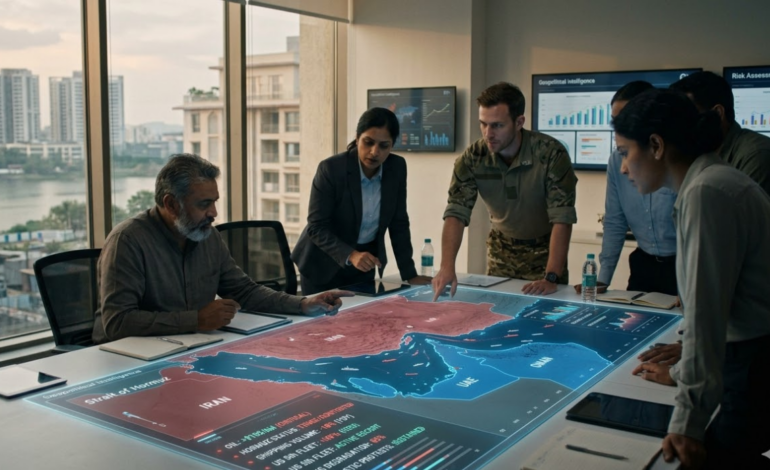
Perhaps the most alarming development in March 2026 is Iran’s threat to indefinitely close the Strait of Hormuz. As the transit point for roughly 20% of the world’s oil supply, any disruption here sends immediate shockwaves through the global economy.
The Demands and the Deadlock
Tehran has issued a series of non-negotiable conditions for reopening the waterway:
-
Full Sanction Relief: The immediate lifting of all primary and secondary economic sanctions.
-
U.S. Withdrawal: The total exit of U.S. military forces from the Persian Gulf and Iraq.
-
Security Guarantees: A permanent halt to Israeli strikes on Iranian territory.
The U.S. and its allies have categorized these demands as “extortion,” leading to a military standoff. The U.S. Fifth Fleet has moved into a high-alert “escort” posture, attempting to maintain the flow of tankers through a corridor that is now under constant threat from Iranian fast-attack craft and anti-ship missiles.
3. The Collapse of the “Axis of Resistance”
A key strategic goal of the 2026 coalition strikes was the systematic isolation of Iran’s regional proxies. In the months leading up to the March escalation, Israel’s “Campaign Between Wars” intensified into a “Campaign of Dismantling.”
-
Lebanon & Syria: Hezbollah’s precision-missile infrastructure has been heavily degraded, and the group currently faces an internal supply crisis as land corridors through Syria are under constant bombardment.
-
Gaza: Following years of sustained conflict, the military capabilities of Hamas and Palestinian Islamic Jihad have been reduced to localized insurgency levels, preventing them from opening a significant “Southern Front” to aid Tehran.
-
The Result: For the first time in the 21st century, Iran finds itself fighting a direct war without the traditional “strategic depth” provided by its regional allies. This isolation has forced the IRGC (Islamic Revolutionary Guard Corps) to expend its own domestic resources, further straining the regime.
4. Internal Crisis: The Regime’s Greatest Threat
While the external war rages, the most dangerous front for the Iranian leadership is domestic. Iran is currently engulfed in the largest sustained protests since the 1979 Revolution.
The Economic Catalyst
The Iranian economy is in a state of freefall. In March 2026, inflation has exceeded 40%, and the rial has reached historic lows against the dollar. Basic goods—medicine, fuel, and bread—are becoming scarce for the average citizen.
-
The Protest Movement: Unlike previous movements, the 2026 protests are no longer confined to the urban middle class. Labor unions, rural communities, and even elements of the traditional merchant class (the Bazaaris) have joined the call for “Zan, Zendegi, Azadi” (Woman, Life, Freedom), which has now evolved into a direct call for regime change.
-
The Brutal Crackdown: The regime has responded with a dual strategy of internet blackouts and lethal force, but the sheer scale of the unrest across multiple provinces has stretched the internal security apparatus to its breaking point.
5. Shifting Global Alliances: The Superpower Pivot
The 2026 conflict has shattered the delicate diplomatic rapprochement that was building in the Middle East.
Russia and China: The Opposing Pole
Moscow and Beijing have issued a joint condemnation of the U.S.-Israeli strikes, viewing them as an illegal violation of sovereignty. However, their support remains largely diplomatic. Russia, still occupied with its own regional conflicts, lacks the surplus military capacity to intervene directly. China, while dependent on Iranian oil, is cautious about a total collapse of global trade and is working behind the scenes to mediate a “limited ceasefire” that protects its energy interests.
Saudi Arabia and Turkey: The Balancing Act
Regional powers like Saudi Arabia and Turkey are in a precarious position. While they view a weakened Iran as a strategic benefit, they are terrified of a “total regional conflagration” that would destroy their own economic “Vision 2030” and “Century of Turkey” projects. Both nations have moved away from their earlier rapprochement with Tehran, re-evaluating their defense pacts with the West as they seek protection from potential Iranian spillover attacks.
6. Global Economic Impact: Oil, Gold, and Market Volatility
The economic consequences of the March 2026 tensions have reached every corner of the globe.
The $100 Barrel and the Energy Crisis
With the Strait of Hormuz under threat, Brent Crude has surged past $105 per barrel. This has triggered an immediate spike in transportation and manufacturing costs worldwide. In the U.S. and Europe, this energy shock is threatening to reignite the inflation that central banks worked so hard to quench in 2024 and 2025.
The Flight to Quality: Gold and Silver ETFs
As global stock markets experience a sharp “double-digit” decline, investors have flocked to safe-haven assets.
-
Gold & Silver: Prices for physical gold and silver, as well as major precious metal ETFs, have reached all-time highs in March 2026.
-
Crypto Paradox: Interestingly, while Bitcoin was once touted as a “digital gold,” it has shown extreme volatility during this crisis, behaving more like a high-risk tech stock than a stable safe-haven, leading many traditional investors back to “Hard Assets.”
Investor Strategy: In times of high-intensity geopolitical risk, diversifying your wealth is critical. To understand how to balance your portfolio between safe-haven cash and growth assets, read our 2026 Global Guide to High-Yield Savings vs. ETFs.
7. The UN and the Failure of Diplomacy
The United Nations security apparatus is under unprecedented strain. The inability of the Permanent Five (P5) members to reach a consensus on a ceasefire has rendered the UN Security Council largely irrelevant in the 2026 crisis. We have returned to an era of “Power Politics,” where diplomatic solutions are being ignored in favor of kinetic outcomes on the battlefield.
FAQ: The 2026 Middle East Conflict
Q: Will the Strait of Hormuz actually be closed?
A: While Iran has the capability to harass shipping with mines and missiles, a total physical closure is difficult to maintain against the combined naval power of the U.S. and its allies. However, even the perception of risk has caused maritime insurance rates to skyrocket, effectively “closing” the route for many commercial carriers.
Q: How does this affect my personal travel plans in 2026?
A: If you are planning to travel to the Middle East or Eastern Mediterranean, expect significant flight rerouting and increased security. For safer, value-driven alternatives this year, see our 2026 Guide to Budget Travel Countries.
Q: Is this the beginning of World War III?
A: Most geopolitical analysts characterize this as a “High-Intensity Regional Conflict.” While it involves superpowers indirectly, there is currently no evidence of a desire for a direct kinetic war between the U.S., Russia, and China.
Q: What is the impact on global food prices?
A: Because of the surge in oil and gas prices (critical for fertilizer and transport), global food inflation is expected to rise by 5–8% in the second half of 2026 if the conflict is not de-escalated by May.
Summary: A World Realigned
The tensions of March 2026 mark the end of the post-Cold War illusion that global trade could exist independently of geopolitical stability. The direct confrontation between the West and Iran has exposed the fragility of global energy corridors and the limitations of international diplomacy.
As the Iranian regime battles for survival against both external bombs and internal dissent, the world must prepare for a new Middle Eastern reality—one where the old proxies are gone, and direct power is the only currency that matters.